Droven.io Enterprise Tech Innovation: A Practical Guide to Modern Business Technology
Technology is changing the way companies build products, manage operations, serve customers, and compete. Artificial intelligence, automation, cloud computing, machine learning, data analytics, cybersecurity, and software development are no longer separate conversations. They increasingly work together as parts of a larger digital strategy.

Technology is changing the way companies build products, manage operations, serve customers, and compete. Artificial intelligence, automation, cloud computing, machine learning, data analytics, cybersecurity, and software development are no longer separate conversations. They increasingly work together as parts of a larger digital strategy.
That is where droven.io enterprise tech innovation becomes an interesting topic.
At first glance, the phrase can sound like the name of an enterprise software product. However, Droven.io's public website presents itself primarily as a technology and AI editorial platform rather than a conventional SaaS application. Its stated focus includes artificial intelligence, emerging technologies, innovative startups, software development, digital transformation, innovation, and the future of work.
So, rather than treating Droven.io as a piece of enterprise software, it is more useful to understand the phrase droven.io enterprise tech innovation as a search topic connecting Droven.io's technology coverage with the broader movement toward technology-driven business transformation.
What Is Droven.io Enterprise Tech Innovation?
Droven.io enterprise tech innovation refers to the technology ideas, trends, tools, and business strategies associated with using modern technology to improve how organizations operate and innovate.
To see how modern media portals organize digital content feeds, read our Glorvix technology portal details covering online publishing architecture.
The important distinction is that Droven.io itself is not presented on its public homepage as an enterprise platform that companies install, deploy, or purchase. It operates as an informational technology resource designed to explain developments across artificial intelligence and related technology fields.
Its published categories provide a useful picture of the areas it covers:
- Artificial intelligence
- AI tools and applications
- Machine learning
- Generative AI
- Robotics
- Startups
- Software development
- Future technology
- Technology news
- AI automation
- Digital transformation
- Cloud computing
- Cybersecurity
- Big data and analytics
This makes the topic broader than a single technology.
The real idea is the intersection between technology innovation and business execution.
A company might use AI to automate customer support, cloud infrastructure to scale an application, analytics to understand customer behavior, or machine learning to improve forecasting. Enterprise tech innovation happens when these technologies are connected to a genuine business problem rather than adopted simply because they are popular.
What Does Droven.io Actually Cover?
Droven.io describes itself as a platform focused on the intersection of artificial intelligence, emerging technology, and modern business. Its homepage specifically highlights AI, emerging technologies, innovative startups, and business strategies shaping the future.
Its content structure also makes the scope clearer.
Artificial Intelligence
The AI section covers areas such as AI tools, machine learning, generative AI, AI applications, automation, and AI-related business topics.
These subjects are particularly important for enterprises because AI is moving beyond experimentation into everyday workflows.
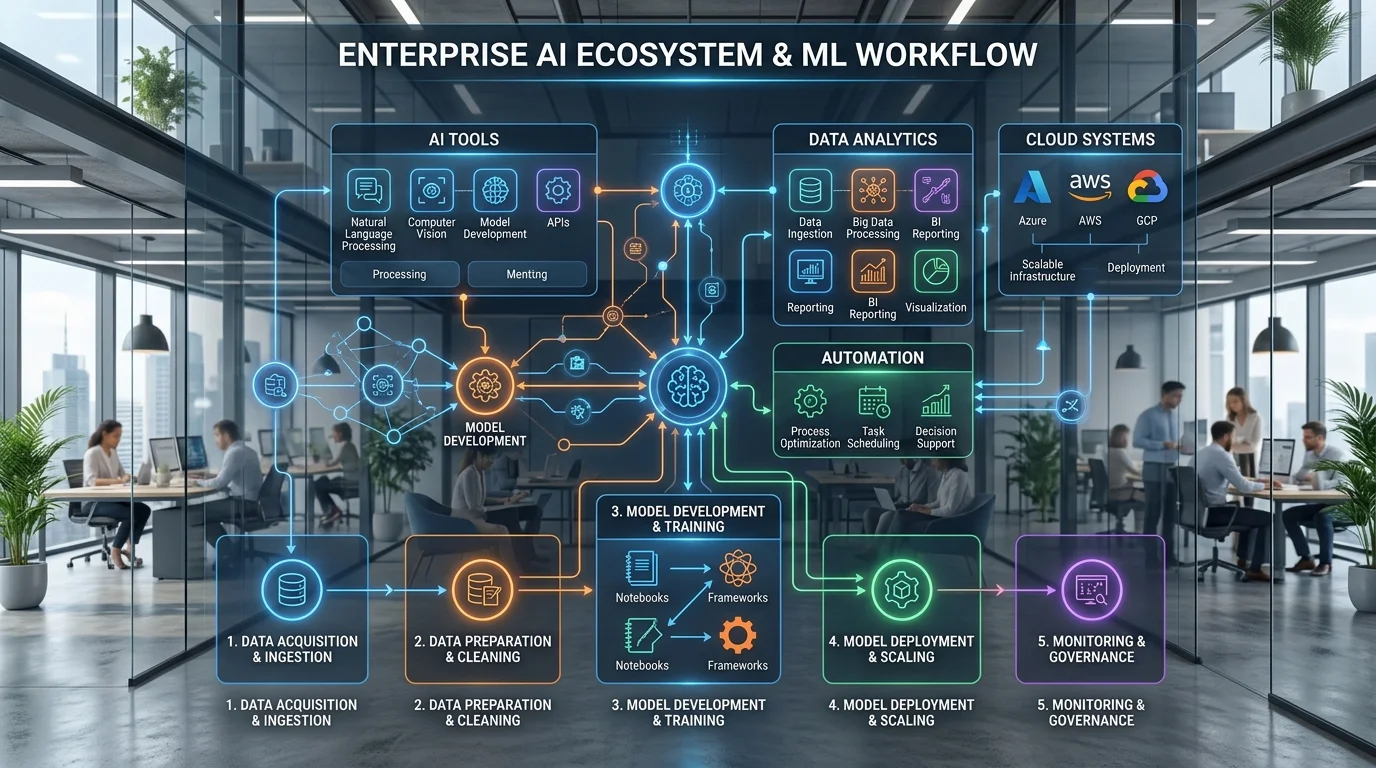
Examples include:
- AI-assisted customer service
- Intelligent document processing
- Predictive analytics
- Generative AI for content and knowledge work
- AI-assisted software development
- Business process automation
- Recommendation systems
- Computer vision
Software and Development
Enterprise innovation depends heavily on software. Droven.io also publishes content around software development, web development, application development, programming languages, AI coding tools, and software tutorials.
This matters because innovation is rarely just about purchasing a tool. Organizations need software systems capable of integrating new technologies into existing workflows.
Emerging Technology
Technology innovation extends beyond AI.
Robotics, quantum computing, advanced computing, connected systems, and other emerging technologies can eventually influence industries ranging from manufacturing to finance and logistics.
The challenge for enterprise decision-makers is separating technology with practical potential from technology that is simply receiving attention.
Startups and Innovation
Startups are another important part of the enterprise innovation ecosystem.
New companies frequently experiment with new business models, AI applications, automation systems, developer tools, and specialized software before those ideas become mainstream.
For established businesses, following startup innovation can therefore provide early visibility into changing technology markets.
Why Enterprise Tech Innovation Matters
Enterprise technology has changed significantly from the traditional model of buying software, installing infrastructure, and maintaining systems.
Modern organizations increasingly expect technology to do more:
- Reduce repetitive work
- Improve decision-making
- Increase productivity
- Make customer experiences more relevant
- Support remote collaboration
- Detect risks earlier
- Scale operations efficiently
- Create new products and services
- Improve access to business information
But there is an important catch.
Technology adoption does not automatically create innovation.
Buying an AI tool does not make an organization innovative. Moving to the cloud does not automatically transform a business. Collecting more data does not guarantee better decisions.
The technology needs to solve a real problem.
That is the principle that makes enterprise tech innovation useful: start with the business outcome, then select the technology.
The Main Technologies Driving Enterprise Innovation
Although enterprise technology changes quickly, several areas continue to appear at the center of digital transformation.
1. Artificial Intelligence
Artificial intelligence is arguably the biggest force reshaping modern enterprise technology.
Organizations use AI to analyze information, automate repetitive activities, generate content, support employees, interact with customers, and identify patterns within large datasets.
Generative AI has expanded this even further by allowing businesses to work with natural language for tasks such as:
- Drafting documents
- Summarizing information
- Creating marketing material
- Analyzing text
- Generating software code
- Answering internal questions
- Building knowledge assistants
Droven.io itself covers AI tools, generative AI, machine learning, AI automation, and AI applications, making artificial intelligence one of the central themes in its technology coverage.
2. Machine Learning and Predictive Analytics
Machine learning enables systems to identify patterns in data and make predictions or recommendations.
For businesses, possible applications include:
- Demand forecasting
- Fraud detection
- Customer segmentation
- Predictive maintenance
- Sales forecasting
- Risk analysis
- Recommendation engines
The value comes from converting historical and real-time information into decisions that would otherwise require significant manual analysis.
3. Cloud Computing
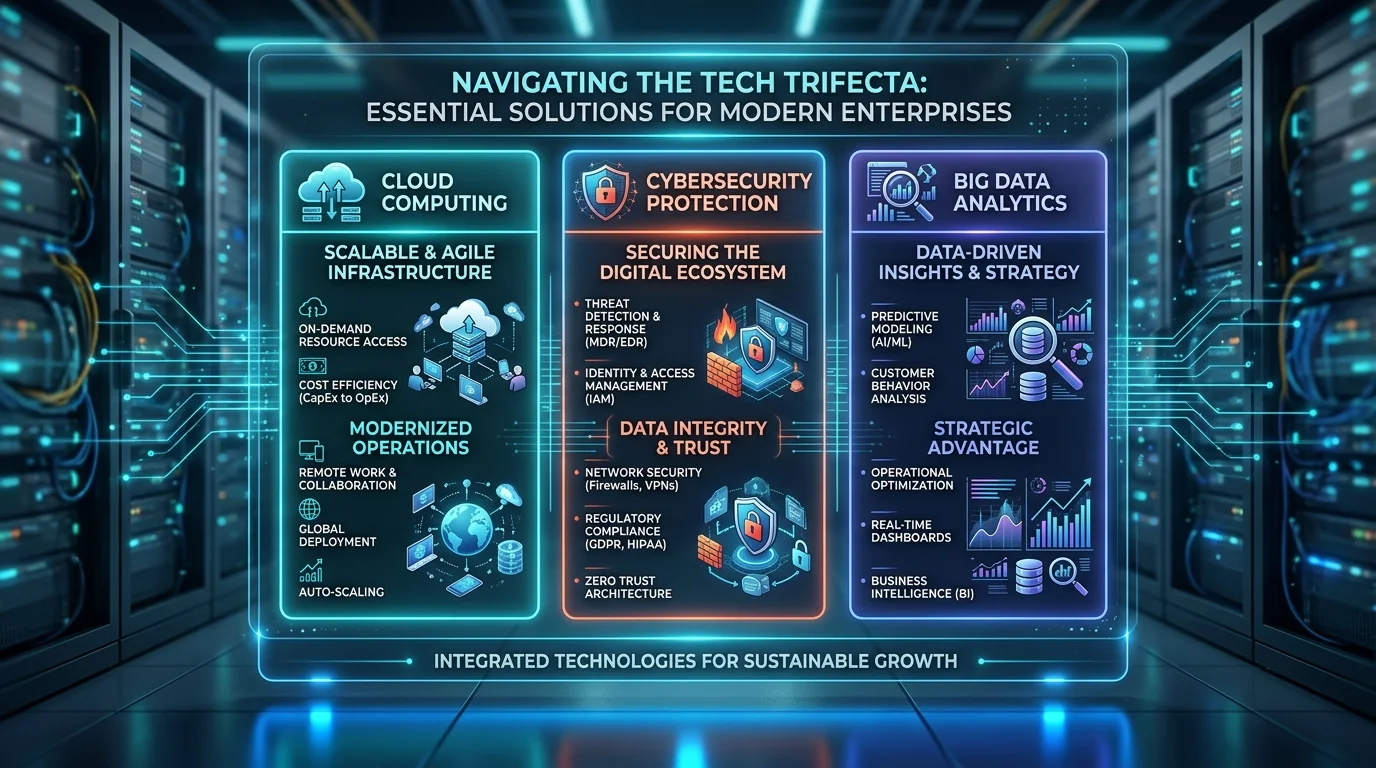
Cloud computing has become a foundation of modern enterprise infrastructure.
Instead of depending entirely on physical servers, organizations can use cloud services for computing, storage, databases, networking, analytics, and application deployment.
Cloud technology can help businesses:
- Scale infrastructure
- Launch applications faster
- Support distributed teams
- Improve resource utilization
- Access advanced computing capabilities
- Reduce dependence on physical infrastructure
Cloud migration is also closely connected with enterprise modernization because modern AI and data workloads often require flexible computing environments.
4. Automation and RPA
Automation focuses on reducing repetitive manual work.
Robotic process automation, workflow automation, and AI-powered automation can be applied to activities such as:
- Data entry
- Invoice processing
- Reporting
- Customer support
- Scheduling
- Document classification
- Internal approvals
The strongest automation projects usually begin with repetitive, clearly defined processes.
Instead of asking, “Where can we use AI?” a better question is:
“Which business process consumes too much time and can be improved without increasing risk?”
5. Data and Analytics
Technology is only as useful as the information behind it.
Businesses generate data through websites, applications, transactions, customer interactions, sensors, internal systems, and third-party platforms.
Analytics can turn this information into insights about:
- Customers
- Sales
- Operations
- Costs
- Marketing performance
- Product usage
- Supply chains
- Business risks
Droven.io's technology categories include big data and analytics as part of its broader digital transformation coverage.
6. Cybersecurity
Innovation also creates new risks.
As companies connect more applications, employees, devices, APIs, cloud systems, and AI services, the technology environment becomes more complicated.
Enterprise innovation therefore needs cybersecurity alongside development.
Important areas include:
- Identity and access management
- Data protection
- Application security
- Network security
- Cloud security
- Threat detection
- Security monitoring
- Privacy and compliance
Security should not be treated as something to add after deployment. It works best when included during technology planning and system design.
How Droven.io Fits Into the Enterprise Technology Landscape
One of the easiest mistakes to make when researching droven.io enterprise tech innovation is assuming that the phrase describes a single enterprise product.
The public website suggests something different.
Droven.io positions itself as an editorial platform providing technology information and insights. Its homepage describes the platform as a source for content about AI, emerging technology, startups, software development, and modern business.
That makes Droven.io more comparable to a technology knowledge resource than to an enterprise SaaS platform.
This distinction is important for readers.
If someone is looking for:
- A software subscription
- Enterprise pricing
- API documentation
- A SaaS dashboard
- Implementation services
- Product licensing
they should not automatically assume those are offered simply because the phrase contains “enterprise tech.”
On the other hand, someone researching AI, emerging technology, software development, startups, automation, or digital innovation may find the site's editorial coverage relevant.
Droven.io Enterprise Tech Innovation vs. Traditional Enterprise IT
Traditional enterprise IT often focuses on keeping existing systems operational.
Enterprise innovation goes a step further.
| Area | Traditional IT | Innovation-Focused Approach |
|---|---|---|
| Infrastructure | Maintain existing systems | Modernize based on business needs |
| Data | Reporting and storage | Real-time insights and predictive analysis |
| AI | Limited experimentation | Embedded into useful workflows |
| Automation | Rule-based tasks | Intelligent and adaptive workflows |
| Software | Build and maintain applications | Continuously improve digital products |
| Security | Protect existing infrastructure | Security integrated into innovation |
| Employees | Operate established processes | Work alongside intelligent tools |
| Strategy | Technology-led | Business-outcome-led |
The difference is not simply “old technology versus new technology.”
It is a difference in how technology is used.
Practical Enterprise Technology Use Cases
Enterprise innovation becomes easier to understand when it is connected to everyday business problems.
Customer Service
AI assistants can help customer-service teams find information, summarize conversations, classify requests, and draft responses.
The objective is not necessarily to remove human support.
In many cases, the better objective is to allow employees to spend less time searching for information and more time solving complex customer problems.
Sales and Marketing
AI and analytics can help teams identify customer patterns, personalize campaigns, analyze performance, and prioritize leads.
Marketing teams can also use generative AI to accelerate first drafts and creative experimentation while keeping human review in the process.
Manufacturing
Manufacturers can combine sensors, analytics, machine learning, and automation to monitor equipment and identify potential problems.
Predictive maintenance is one example: instead of waiting for a machine to fail, businesses can use operational data to identify warning signs.
Finance
Financial organizations can use machine learning and analytics for fraud detection, risk assessment, anomaly detection, forecasting, and process automation.
Because financial systems are highly regulated, innovation must be balanced with security, explainability, governance, and compliance.
Human Resources
Technology can assist with workforce analytics, employee support, scheduling, training, and knowledge management.
However, sensitive HR decisions require careful human oversight because automated systems can introduce bias or produce inappropriate recommendations.
How to Build an Enterprise Tech Innovation Strategy
A technology strategy does not need to begin with a massive transformation program.
A practical approach can start small.
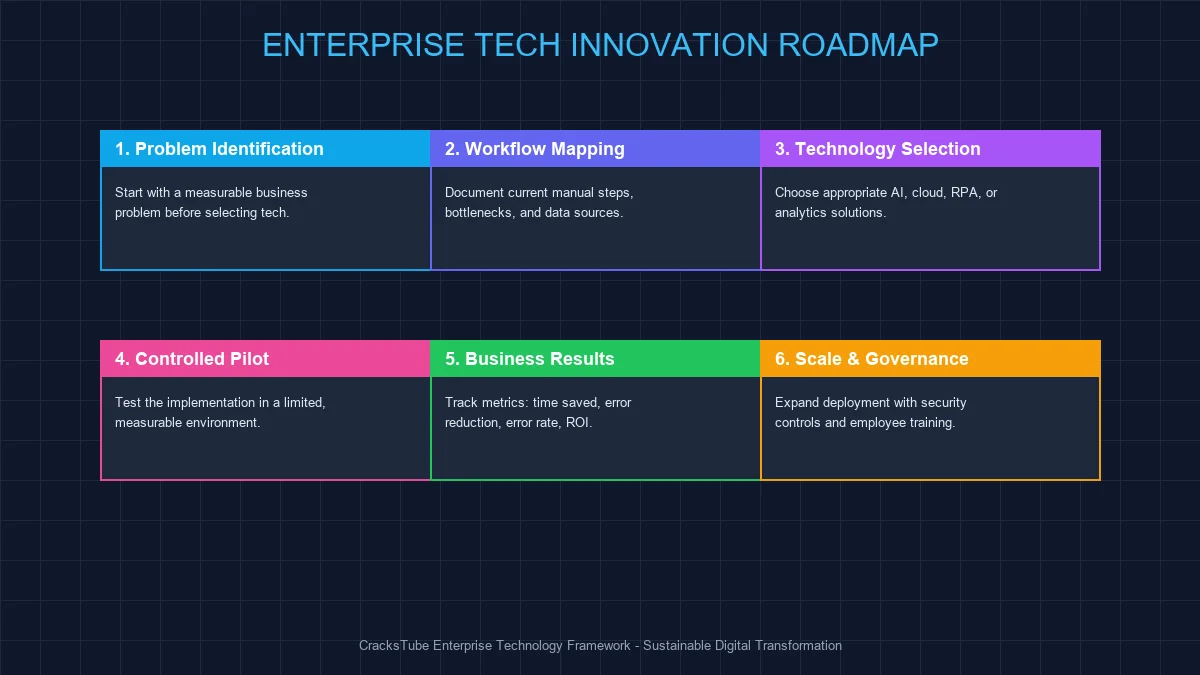
Step 1: Identify the Business Problem
Start with a measurable problem.
For example:
“Customer-service employees spend three hours every day searching across different systems for information.”
That is a better starting point than:
“We need to implement generative AI.”
The first statement identifies a problem. The second jumps directly to a technology.
Step 2: Map the Existing Workflow
Document how the process works today.
Identify:
- Manual steps
- Repetitive tasks
- Bottlenecks
- Data sources
- Approval requirements
- Security concerns
- Systems involved
This creates a baseline for improvement.
Step 3: Select the Appropriate Technology
Only after understanding the workflow should the organization decide whether it needs:
- AI
- Machine learning
- RPA
- Cloud infrastructure
- Analytics
- New software
- API integration
- Cybersecurity improvements
Sometimes the correct answer is not AI at all.
A simple workflow automation may solve the problem more effectively.
Step 4: Run a Controlled Pilot
Instead of transforming the entire organization immediately, test the idea within a limited environment.
A good pilot should have:
- A clearly defined user group
- A measurable objective
- A limited timeframe
- Known risks
- Success criteria
Step 5: Measure Business Results
Technology projects need measurable outcomes.
Useful metrics include:
- Time saved per process
- Cost reduction
- Error reduction
- Revenue impact
- Customer satisfaction
- Employee productivity
- Processing speed
- System reliability
Step 6: Scale Carefully
If the pilot works, expand it.
Scaling should include:
- Security review
- Data governance
- Employee training
- Integration testing
- Performance monitoring
- Documentation
- Ongoing measurement
This approach reduces the risk of spending heavily on technology before proving that it works.
The Role of Human Expertise in Enterprise Innovation
It is easy to frame enterprise innovation as a competition between humans and machines.
That is usually too simplistic.
The more useful model is human expertise supported by technology.
AI can process information quickly, but people remain responsible for context, judgment, accountability, creativity, and strategic decisions.
For example, an AI system may identify unusual financial activity. A human investigator can then determine whether that activity represents legitimate business behavior or potential fraud.
Likewise, an AI coding assistant can generate code, but experienced developers still need to review architecture, security, performance, and maintainability.
The best enterprise implementations therefore combine automation with appropriate human oversight.
Common Enterprise Technology Mistakes
Innovation projects often fail for reasons that have little to do with the underlying technology.
Choosing technology before defining the problem
A company may adopt AI simply because competitors are doing it.
That can result in unnecessary complexity.
Ignoring existing systems
Most enterprises already have databases, applications, APIs, security systems, and legacy infrastructure.
New technology has to coexist with these systems.
Treating data quality as an afterthought
Poor-quality data can produce poor analytics and unreliable AI results.
Forgetting employees
A technically impressive system can fail if employees do not understand it or do not want to use it.
Training and change management matter.
Scaling too quickly
A successful pilot does not automatically mean the system is ready for thousands of users.
Enterprise-scale deployment introduces additional security, performance, governance, and support requirements.
Measuring activity instead of outcomes
Number of AI prompts, users, or automated workflows may look impressive, but they do not necessarily demonstrate business value.
The better question is:
What improved because the technology was introduced?
What Makes Enterprise Tech Innovation Sustainable?
Sustainable innovation is not about continuously adopting every new technology.
It is about creating an organization capable of evaluating, testing, adopting, and retiring technology intelligently.
Five principles are particularly important:
- Business alignment — technology should support clear organizational goals.
- Reliable data — AI and analytics require usable information.
- Security by design — innovation should not create unmanaged risk.
- Human adoption — employees need training and appropriate involvement.
- Continuous measurement — successful systems should demonstrate measurable value.
These principles apply whether a business is experimenting with generative AI, migrating workloads to the cloud, implementing automation, or building a new software product.
Who Can Benefit From Following Enterprise Tech Innovation?
The subject is relevant to a wide range of readers.
Business Owners
Business owners can use technology research to identify opportunities for improving productivity and customer experience.
CIOs and CTOs
Technology leaders need to evaluate emerging technologies while balancing cost, security, architecture, and business priorities.
Developers
Developers can follow changes in programming tools, AI coding systems, frameworks, and software architecture.
Startup Founders
Founders can use emerging technology to identify new product opportunities and build more efficient operations.
IT Professionals
IT teams need to understand cloud infrastructure, cybersecurity, automation, networking, and emerging technology.
Students and Technology Enthusiasts
Technology content can also provide a practical introduction to rapidly changing areas such as AI, robotics, machine learning, and software development.
Why Droven.io Enterprise Tech Innovation Is a Useful Search Topic
The value of the phrase lies in the combination of two ideas.
Droven.io represents a technology-focused editorial resource.
Enterprise tech innovation represents the larger business movement toward AI, automation, software, analytics, cloud computing, and emerging technology.
Together, the topic gives readers a useful starting point for understanding how different technologies connect with modern business.
It also avoids a common mistake in technology research: treating every emerging tool as an isolated product.
Real enterprise innovation is rarely isolated.
An AI application may depend on cloud infrastructure. Cloud systems depend on security. AI models depend on data. Data systems depend on software engineering. And successful deployment depends on people.
That interconnected nature is what makes enterprise technology both challenging and valuable.
Frequently Asked Questions About Droven.io Enterprise Tech Innovation
Based on its current public website, Droven.io presents itself as an editorial technology platform rather than a conventional enterprise SaaS product. Its stated focus includes AI, emerging technology, software development, startups, and modern business.
The phrase generally refers to the relationship between Droven.io's technology-focused content and the broader field of enterprise technology innovation, including AI, automation, cloud computing, analytics, software development, cybersecurity, and emerging technologies.
Major areas include artificial intelligence, machine learning, generative AI, cloud computing, automation, robotics, data analytics, cybersecurity, software development, and other emerging technologies.
Yes. The underlying principles are not limited to large corporations. Small businesses can use automation, analytics, AI tools, cloud software, and digital workflows to improve efficiency and scale operations.
No. AI is one component of enterprise technology innovation. A broader innovation strategy can also include cloud infrastructure, software engineering, cybersecurity, analytics, robotics, automation, and digital transformation.
Start with a business problem rather than a technology trend. Define the desired outcome, map the current workflow, evaluate appropriate technologies, run a controlled pilot, measure the results, and scale only after the solution has demonstrated value.
Not necessarily. In many cases, modernization happens by integrating new technology with existing infrastructure. APIs, cloud services, automation platforms, and data integration can allow organizations to modernize without replacing everything at once.
New applications, cloud systems, AI tools, and connected devices can introduce additional security risks. Security, privacy, identity management, and governance should therefore be considered during the design and deployment of new technology.
Final Takeaway
Droven.io enterprise tech innovation is best understood as a technology research topic rather than the name of a single enterprise software product.
Droven.io's public platform focuses on artificial intelligence, emerging technology, startups, software development, and modern business, while its broader technology categories cover areas such as machine learning, generative AI, robotics, automation, and future technology.
The larger lesson behind enterprise tech innovation is straightforward: businesses should not adopt technology simply because it is new.
They should adopt it because it solves a meaningful problem.
At first glance, the phrase can sound like the name of an enterprise software product. However, Droven.io's public website presents itself primarily as a technology and AI editorial platform rather than a conventional SaaS application. Its stated focus includes artificial intelligence, emerging technologies, innovative startups, software development, digital transformation, innovation, and the future of work.
So, rather than treating Droven.io as a piece of enterprise software, it is more useful to understand the phrase droven.io enterprise tech innovation as a search topic connecting Droven.io's technology coverage with the broader movement toward technology-driven business transformation.
What Is Droven.io Enterprise Tech Innovation?
Droven.io enterprise tech innovation refers to the technology ideas, trends, tools, and business strategies associated with using modern technology to improve how organizations operate and innovate.
Users seeking interactive media utilities and gaming mod networks can check out our ModCityUSA modding community overview.
The important distinction is that Droven.io itself is not presented on its public homepage as an enterprise platform that companies install, deploy, or purchase. It operates as an informational technology resource designed to explain developments across artificial intelligence and related technology fields.
Its published categories provide a useful picture of the areas it covers:
- Artificial intelligence
- AI tools and applications
- Machine learning
- Generative AI
- Robotics
- Startups
- Software development
- Future technology
- Technology news
- AI automation
- Digital transformation
- Cloud computing
- Cybersecurity
- Big data and analytics
This makes the topic broader than a single technology.
The real idea is the intersection between technology innovation and business execution.
A company might use AI to automate customer support, cloud infrastructure to scale an application, analytics to understand customer behavior, or machine learning to improve forecasting. Enterprise tech innovation happens when these technologies are connected to a genuine business problem rather than adopted simply because they are popular.
What Does Droven.io Actually Cover?
Droven.io describes itself as a platform focused on the intersection of artificial intelligence, emerging technology, and modern business. Its homepage specifically highlights AI, emerging technologies, innovative startups, and business strategies shaping the future.
Its content structure also makes the scope clearer.
Artificial Intelligence
The AI section covers areas such as AI tools, machine learning, generative AI, AI applications, automation, and AI-related business topics.
These subjects are particularly important for enterprises because AI is moving beyond experimentation into everyday workflows.
Examples include:
- AI-assisted customer service
- Intelligent document processing
- Predictive analytics
- Generative AI for content and knowledge work
- AI-assisted software development
- Business process automation
- Recommendation systems
- Computer vision
Software and Development
Enterprise innovation depends heavily on software. Droven.io also publishes content around software development, web development, application development, programming languages, AI coding tools, and software tutorials.
This matters because innovation is rarely just about purchasing a tool. Organizations need software systems capable of integrating new technologies into existing workflows.
Emerging Technology
Technology innovation extends beyond AI.
Robotics, quantum computing, advanced computing, connected systems, and other emerging technologies can eventually influence industries ranging from manufacturing to finance and logistics.
The challenge for enterprise decision-makers is separating technology with practical potential from technology that is simply receiving attention.
Startups and Innovation
Startups are another important part of the enterprise innovation ecosystem.
New companies frequently experiment with new business models, AI applications, automation systems, developer tools, and specialized software before those ideas become mainstream.
For established businesses, following startup innovation can therefore provide early visibility into changing technology markets.
Why Enterprise Tech Innovation Matters
Enterprise technology has changed significantly from the traditional model of buying software, installing infrastructure, and maintaining systems.
Modern organizations increasingly expect technology to do more:
- Reduce repetitive work
- Improve decision-making
- Increase productivity
- Make customer experiences more relevant
- Support remote collaboration
- Detect risks earlier
- Scale operations efficiently
- Create new products and services
- Improve access to business information
But there is an important catch.
Technology adoption does not automatically create innovation.
Buying an AI tool does not make an organization innovative. Moving to the cloud does not automatically transform a business. Collecting more data does not guarantee better decisions.
The technology needs to solve a real problem.
That is the principle that makes enterprise tech innovation useful: start with the business outcome, then select the technology.
The Main Technologies Driving Enterprise Innovation
Although enterprise technology changes quickly, several areas continue to appear at the center of digital transformation.
1. Artificial Intelligence
Artificial intelligence is arguably the biggest force reshaping modern enterprise technology.
Organizations use AI to analyze information, automate repetitive activities, generate content, support employees, interact with customers, and identify patterns within large datasets.
Generative AI has expanded this even further by allowing businesses to work with natural language for tasks such as:
- Drafting documents
- Summarizing information
- Creating marketing material
- Analyzing text
- Generating software code
- Answering internal questions
- Building knowledge assistants
Droven.io itself covers AI tools, generative AI, machine learning, AI automation, and AI applications, making artificial intelligence one of the central themes in its technology coverage.
2. Machine Learning and Predictive Analytics
Machine learning enables systems to identify patterns in data and make predictions or recommendations.
For businesses, possible applications include:
- Demand forecasting
- Fraud detection
- Customer segmentation
- Predictive maintenance
- Sales forecasting
- Risk analysis
- Recommendation engines
The value comes from converting historical and real-time information into decisions that would otherwise require significant manual analysis.
3. Cloud Computing
Cloud computing has become a foundation of modern enterprise infrastructure.
Instead of depending entirely on physical servers, organizations can use cloud services for computing, storage, databases, networking, analytics, and application deployment.
Cloud technology can help businesses:
- Scale infrastructure
- Launch applications faster
- Support distributed teams
- Improve resource utilization
- Access advanced computing capabilities
- Reduce dependence on physical infrastructure
Cloud migration is also closely connected with enterprise modernization because modern AI and data workloads often require flexible computing environments.
4. Automation and RPA
Automation focuses on reducing repetitive manual work.
Robotic process automation, workflow automation, and AI-powered automation can be applied to activities such as:
- Data entry
- Invoice processing
- Reporting
- Customer support
- Scheduling
- Document classification
- Internal approvals
The strongest automation projects usually begin with repetitive, clearly defined processes.
Instead of asking, “Where can we use AI?” a better question is:
“Which business process consumes too much time and can be improved without increasing risk?”
5. Data and Analytics
Technology is only as useful as the information behind it.
Businesses generate data through websites, applications, transactions, customer interactions, sensors, internal systems, and third-party platforms.
Analytics can turn this information into insights about:
- Customers
- Sales
- Operations
- Costs
- Marketing performance
- Product usage
- Supply chains
- Business risks
Droven.io's technology categories include big data and analytics as part of its broader digital transformation coverage.
6. Cybersecurity
Innovation also creates new risks.
As companies connect more applications, employees, devices, APIs, cloud systems, and AI services, the technology environment becomes more complicated.
Enterprise innovation therefore needs cybersecurity alongside development.
Important areas include:
- Identity and access management
- Data protection
- Application security
- Network security
- Cloud security
- Threat detection
- Security monitoring
- Privacy and compliance
Security should not be treated as something to add after deployment. It works best when included during technology planning and system design.
How Droven.io Fits Into the Enterprise Technology Landscape
One of the easiest mistakes to make when researching droven.io enterprise tech innovation is assuming that the phrase describes a single enterprise product.
The public website suggests something different.
Droven.io positions itself as an editorial platform providing technology information and insights. Its homepage describes the platform as a source for content about AI, emerging technology, startups, software development, and modern business.
That makes Droven.io more comparable to a technology knowledge resource than to an enterprise SaaS platform.
This distinction is important for readers.
If someone is looking for:
- A software subscription
- Enterprise pricing
- API documentation
- A SaaS dashboard
- Implementation services
- Product licensing
they should not automatically assume those are offered simply because the phrase contains “enterprise tech.”
On the other hand, someone researching AI, emerging technology, software development, startups, automation, or digital innovation may find the site's editorial coverage relevant.
Droven.io Enterprise Tech Innovation vs. Traditional Enterprise IT
Traditional enterprise IT often focuses on keeping existing systems operational.
Enterprise innovation goes a step further.
| Area | Traditional IT | Innovation-Focused Approach |
|---|---|---|
| Infrastructure | Maintain existing systems | Modernize based on business needs |
| Data | Reporting and storage | Real-time insights and predictive analysis |
| AI | Limited experimentation | Embedded into useful workflows |
| Automation | Rule-based tasks | Intelligent and adaptive workflows |
| Software | Build and maintain applications | Continuously improve digital products |
| Security | Protect existing infrastructure | Security integrated into innovation |
| Employees | Operate established processes | Work alongside intelligent tools |
| Strategy | Technology-led | Business-outcome-led |
The difference is not simply “old technology versus new technology.”
It is a difference in how technology is used.
Practical Enterprise Technology Use Cases
Enterprise innovation becomes easier to understand when it is connected to everyday business problems.
Customer Service
AI assistants can help customer-service teams find information, summarize conversations, classify requests, and draft responses.
The objective is not necessarily to remove human support.
In many cases, the better objective is to allow employees to spend less time searching for information and more time solving complex customer problems.
Sales and Marketing
AI and analytics can help teams identify customer patterns, personalize campaigns, analyze performance, and prioritize leads.
Marketing teams can also use generative AI to accelerate first drafts and creative experimentation while keeping human review in the process.
Manufacturing
Manufacturers can combine sensors, analytics, machine learning, and automation to monitor equipment and identify potential problems.
Predictive maintenance is one example: instead of waiting for a machine to fail, businesses can use operational data to identify warning signs.
Finance
Financial organizations can use machine learning and analytics for fraud detection, risk assessment, anomaly detection, forecasting, and process automation.
Because financial systems are highly regulated, innovation must be balanced with security, explainability, governance, and compliance.
Human Resources
Technology can assist with workforce analytics, employee support, scheduling, training, and knowledge management.
However, sensitive HR decisions require careful human oversight because automated systems can introduce bias or produce inappropriate recommendations.
How to Build an Enterprise Tech Innovation Strategy
A technology strategy does not need to begin with a massive transformation program.
A practical approach can start small.
Step 1: Identify the Business Problem
Start with a measurable problem.
For example:
“Customer-service employees spend three hours every day searching across different systems for information.”
That is a better starting point than:
“We need to implement generative AI.”
The first statement identifies a problem. The second jumps directly to a technology.
Step 2: Map the Existing Workflow
Document how the process works today.
Identify:
- Manual steps
- Repetitive tasks
- Bottlenecks
- Data sources
- Approval requirements
- Security concerns
- Systems involved
This creates a baseline for improvement.
Step 3: Select the Appropriate Technology
Only after understanding the workflow should the organization decide whether it needs:
- AI
- Machine learning
- RPA
- Cloud infrastructure
- Analytics
- New software
- API integration
- Cybersecurity improvements
Sometimes the correct answer is not AI at all.
A simple workflow automation may solve the problem more effectively.
Step 4: Run a Controlled Pilot
Instead of transforming the entire organization immediately, test the idea within a limited environment.
A good pilot should have:
- A clearly defined user group
- A measurable objective
- A limited timeframe
- Known risks
- Success criteria
Step 5: Measure Business Results
Technology projects need measurable outcomes.
Useful metrics include:
- Time saved per process
- Cost reduction
- Error reduction
- Revenue impact
- Customer satisfaction
- Employee productivity
- Processing speed
- System reliability
Step 6: Scale Carefully
If the pilot works, expand it.
Scaling should include:
- Security review
- Data governance
- Employee training
- Integration testing
- Performance monitoring
- Documentation
- Ongoing measurement
This approach reduces the risk of spending heavily on technology before proving that it works.
The Role of Human Expertise in Enterprise Innovation
It is easy to frame enterprise innovation as a competition between humans and machines.
That is usually too simplistic.
The more useful model is human expertise supported by technology.
AI can process information quickly, but people remain responsible for context, judgment, accountability, creativity, and strategic decisions.
For example, an AI system may identify unusual financial activity. A human investigator can then determine whether that activity represents legitimate business behavior or potential fraud.
Likewise, an AI coding assistant can generate code, but experienced developers still need to review architecture, security, performance, and maintainability.
The best enterprise implementations therefore combine automation with appropriate human oversight.
Common Enterprise Technology Mistakes
Innovation projects often fail for reasons that have little to do with the underlying technology.
Choosing technology before defining the problem
A company may adopt AI simply because competitors are doing it.
That can result in unnecessary complexity.
Ignoring existing systems
Most enterprises already have databases, applications, APIs, security systems, and legacy infrastructure.
New technology has to coexist with these systems.
Treating data quality as an afterthought
Poor-quality data can produce poor analytics and unreliable AI results.
Forgetting employees
A technically impressive system can fail if employees do not understand it or do not want to use it.
Training and change management matter.
Scaling too quickly
A successful pilot does not automatically mean the system is ready for thousands of users.
Enterprise-scale deployment introduces additional security, performance, governance, and support requirements.
Measuring activity instead of outcomes
Number of AI prompts, users, or automated workflows may look impressive, but they do not necessarily demonstrate business value.
The better question is:
What improved because the technology was introduced?
What Makes Enterprise Tech Innovation Sustainable?
Sustainable innovation is not about continuously adopting every new technology.
It is about creating an organization capable of evaluating, testing, adopting, and retiring technology intelligently.
Five principles are particularly important:
- Business alignment — technology should support clear organizational goals.
- Reliable data — AI and analytics require usable information.
- Security by design — innovation should not create unmanaged risk.
- Human adoption — employees need training and appropriate involvement.
- Continuous measurement — successful systems should demonstrate measurable value.
These principles apply whether a business is experimenting with generative AI, migrating workloads to the cloud, implementing automation, or building a new software product.
Who Can Benefit From Following Enterprise Tech Innovation?
The subject is relevant to a wide range of readers.
Business Owners
Business owners can use technology research to identify opportunities for improving productivity and customer experience.
CIOs and CTOs
Technology leaders need to evaluate emerging technologies while balancing cost, security, architecture, and business priorities.
Developers
Developers can follow changes in programming tools, AI coding systems, frameworks, and software architecture.
Startup Founders
Founders can use emerging technology to identify new product opportunities and build more efficient operations.
IT Professionals
IT teams need to understand cloud infrastructure, cybersecurity, automation, networking, and emerging technology.
Students and Technology Enthusiasts
Technology content can also provide a practical introduction to rapidly changing areas such as AI, robotics, machine learning, and software development.
Why Droven.io Enterprise Tech Innovation Is a Useful Search Topic
The value of the phrase lies in the combination of two ideas.
Droven.io represents a technology-focused editorial resource.
Enterprise tech innovation represents the larger business movement toward AI, automation, software, analytics, cloud computing, and emerging technology.
Together, the topic gives readers a useful starting point for understanding how different technologies connect with modern business.
It also avoids a common mistake in technology research: treating every emerging tool as an isolated product.
Real enterprise innovation is rarely isolated.
An AI application may depend on cloud infrastructure. Cloud systems depend on security. AI models depend on data. Data systems depend on software engineering. And successful deployment depends on people.
That interconnected nature is what makes enterprise technology both challenging and valuable.
Frequently Asked Questions About Droven.io Enterprise Tech Innovation
Based on its current public website, Droven.io presents itself as an editorial technology platform rather than a conventional enterprise SaaS product. Its stated focus includes AI, emerging technology, software development, startups, and modern business.
The phrase generally refers to the relationship between Droven.io's technology-focused content and the broader field of enterprise technology innovation, including AI, automation, cloud computing, analytics, software development, cybersecurity, and emerging technologies.
Major areas include artificial intelligence, machine learning, generative AI, cloud computing, automation, robotics, data analytics, cybersecurity, software development, and other emerging technologies.
Yes. The underlying principles are not limited to large corporations. Small businesses can use automation, analytics, AI tools, cloud software, and digital workflows to improve efficiency and scale operations.
No. AI is one component of enterprise technology innovation. A broader innovation strategy can also include cloud infrastructure, software engineering, cybersecurity, analytics, robotics, automation, and digital transformation.
Start with a business problem rather than a technology trend. Define the desired outcome, map the current workflow, evaluate appropriate technologies, run a controlled pilot, measure the results, and scale only after the solution has demonstrated value.
Not necessarily. In many cases, modernization happens by integrating new technology with existing infrastructure. APIs, cloud services, automation platforms, and data integration can allow organizations to modernize without replacing everything at once.
New applications, cloud systems, AI tools, and connected devices can introduce additional security risks. Security, privacy, identity management, and governance should therefore be considered during the design and deployment of new technology.
Final Takeaway
Droven.io enterprise tech innovation is best understood as a technology research topic rather than the name of a single enterprise software product.
To explore automated web tools and social media utility services, read our breakdown on TechyHitTools web utility guide.
Droven.io's public platform focuses on artificial intelligence, emerging technology, startups, software development, and modern business, while its broader technology categories cover areas such as machine learning, generative AI, robotics, automation, and future technology.
The larger lesson behind enterprise tech innovation is straightforward: businesses should not adopt technology simply because it is new.
They should adopt it because it solves a meaningful problem.
Whether that means using AI to reduce repetitive work, analytics to improve decisions, cloud infrastructure to scale applications, automation to streamline operations, or cybersecurity to protect digital assets, successful innovation starts with a business objective and ends with a measurable result.
That is ultimately what makes enterprise technology useful—not the novelty of the technology itself, but the improvement it creates for the organization using it.
For more such useful information read our site crackstube.blog